Thistle Hill – Blog

…doing what comes naturally

On our home page….

by David

We wanted to alert those who skip our Home Page and come direct to this blog that we’ve posted some pictures of our 688 line-bred calves there.

We’re not entirely convinced that breeding a sire (even one as good as Rotokawa 688) to his daughter is a good idea.  But in these matters, at least, we think it’s a good idea to try something for ourselves before making a decision.

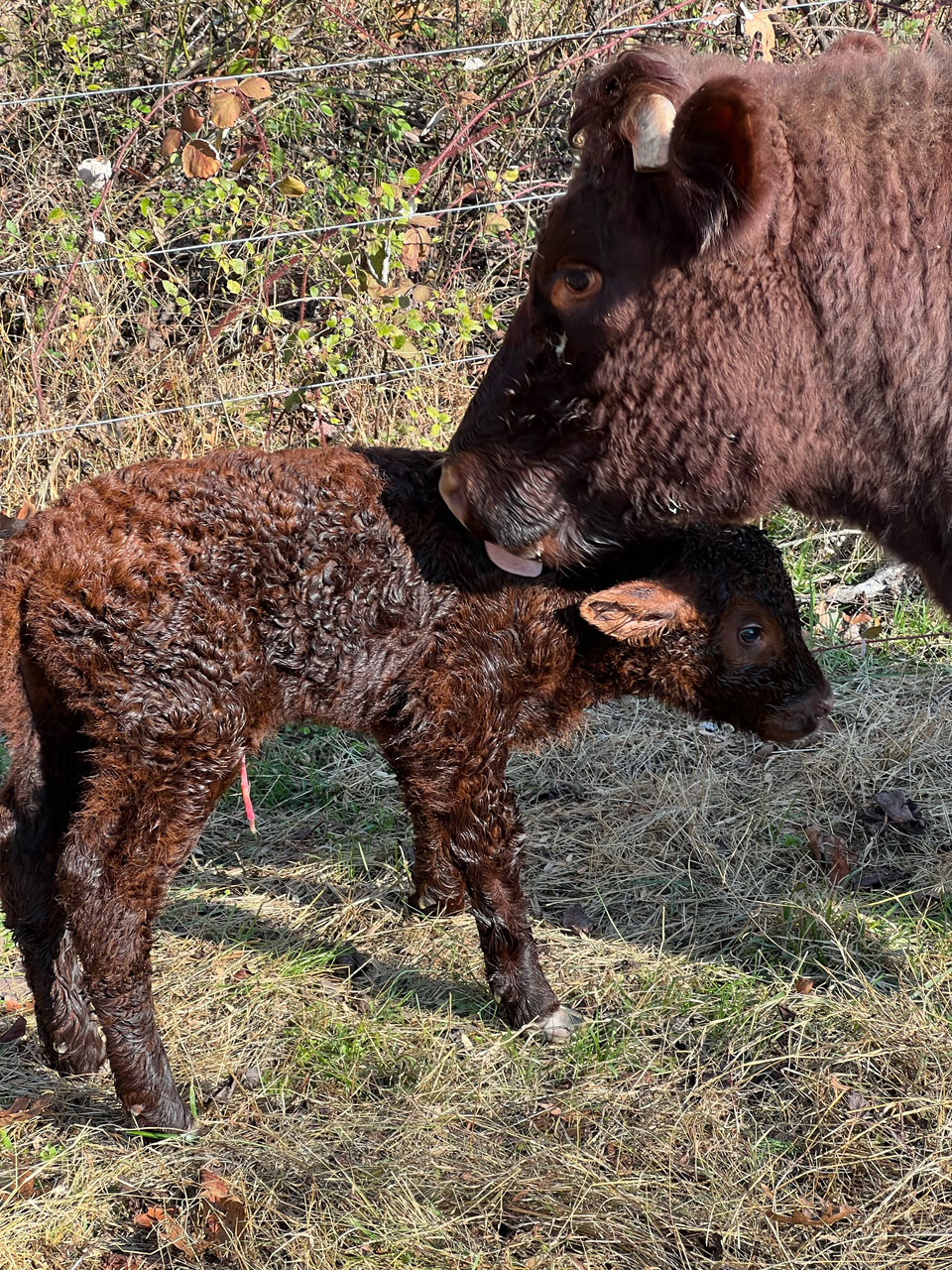
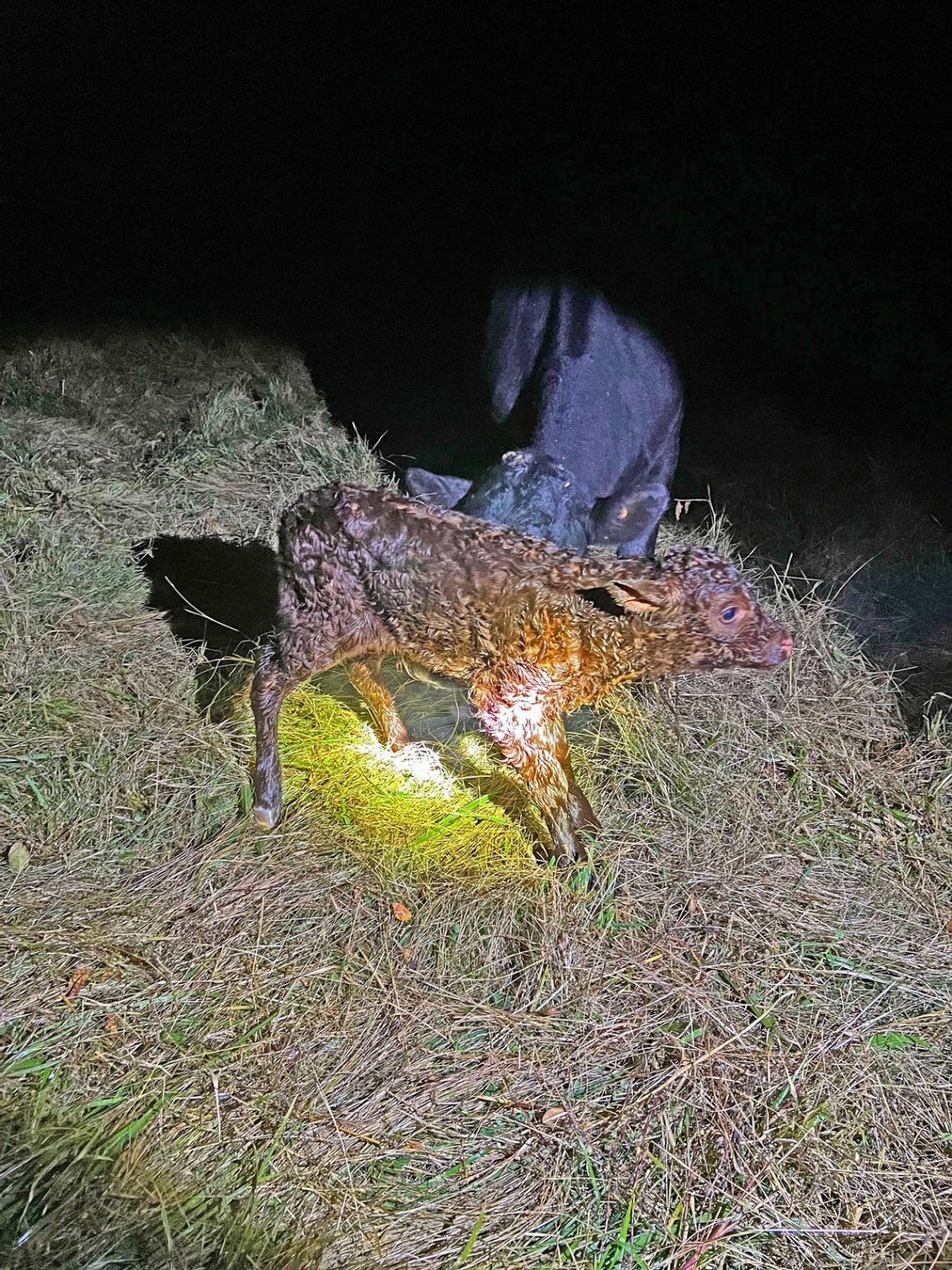
So far, the results have been excellent.  Of the 10 embryos implanted, we got seven calves…two males and five females.  One of the bull calves died at about six months and, while we think it was the shock of a nearby lightning strike, we cannot rule out what is called a “fatal gene” which does show up in this kind of mating.

We would grade four of the five females good to excellent and, since recipient mothers are involved in this program, we’re not ready to rule out that the fifth will yet make up ground for what might have been poorer nutrition from its dam.  In any event, we have another year to decide on that and the next breeding decision.  Typically, these heifers would be mated with another close relative, an uncle or a brother.  That’s when it will become interesting.

What we are doing with this, of course, is concentrating the genetics; we trust,  good genetics.  But, if we are mistaken in our judgment, we could also be concentrating the genetics of traits we don’t want.

About those gestation cages….

by David

…here’s a picture of your McDonald’s breakfast Sausage McMuffin I ran across on a political blog today.  The company is asking its producers to stop the practice…sometime in the future.  But their recommendation is to put the sows in the same kind of crowded housing they use for their piglets and continue pumping them full of antibiotics and hormones to keep them growing and breeding….until they drop.  For now, you can see the pigs can’t even turn around.

Thistle Hill pigs are entirely free range, grazing with the cows and rooting for acorns.  You may not have believed me the other day when I said we could tell they were happy.  Check out the smile on the one on the left!  (click to enlarge)

Sometimes they push the envelope.  Yesterday we found them in the pasture across the road.  When we led them back home they actually stopped at the pavement and checked both ways several times before crossing.  (No, they didn’t “wee-wee” all the way home.  More like grunting.)

Wooz wonders whether the shortage of Vitamin D in so many Americans is due to the prevelance of confinement operations.  Almost all pigs and chickens never see the sun their entire lives….not even those advertised as “organic, free range” by the big producers.  In fact, they have only a tiny pen at the end of sheds holding thousands of animals.  Only a few ever manage to squeeze outside but they have “access” as the government requires.

The same is true of most of the organic milk in the supermarkets.

The point is you should not only buy your food locally, but you should visit the farm yourself to be sure humane methods are being used.  You’re always welcome to visit Thistle Hill!


Better living through chemistry…

by David

More and more, I find myself wondering how long man can continue playing with Nature before we pay the ultimate price.  Experiments with that ultra-flu virus make me think that way.  So does reading that scientists in the Netherlands have developed a glob they think is artificial beef.  The first hamburger will be ready to serve in the Fall.

http://www.telegraph.co.uk/science/science-news/9091628/Test-tube-hamburgers-to-be-served-this-year.html

There’s a somewhat limited market for a $400,000 dollar hamburger but mass production will kick in and take care of that.  But what would be the real price of such a burger?  And I don’t mean all the un-calculated real costs in energy and transportation and minerals involved in production.  I mean those little facts glossed over in the story: that it grows in a dish “rich in nutrients” (artificial nutrients, presumably) and that the color isn’t appetizing so it will have to be dyed.  Presumably not with Red Dye 2 or 40.  Don’t get too curious about the fat that will have to be added.

We’re only now beginning to realize that genetically modified foods—the last big break-through from the chemical giants—aren’t behaving as predicted.  Weird things are happening in the soil…new weeds are developing that can’t be eradicated with any known herbicide.  New illnesses are one of the side effects, too.  And, by the way, turns out the yields aren’t better, after all.

The one clear beneficiary is Monsanto, which now controls the seeds and pity the poor farmer who has some GMO corn in his field which blew over from his neighbor’s field, even if that neighbor is miles away.

It’s all a part of our ego, our refusal to accept Nature’s limits.  And so agriculture keeps pushing for more and bigger.  And when that kills the soil, just pour on more fertilizer.  And when that kills the microbes beneath the soil, bring in jugs of bottled microbes and pour them on, too.

We see it among our friends, who are mostly of our own “certain age”.  Sit down to a meal and a string of pills are laid out and conversation soon reveals some of the pills are for the other pills.  And we know young people, too, who are on a diet of chemicals…some to “take them down” and some to pick them up.

Surveys may indicate that by 2 to 1, we don’t want chemical hamburgers.  We don’t want genetically modified food either.  But we have it.  Banned in Europe, today GM vegetables and meat are a part of every American diet.

We read that about 10% of Americans are vigorously resisting, buying carefully and searching out healthy, locally-grown food.  But it’s hard work, and most of us are just “too busy”.  Meanwhile, our government is cracking down; cracking down on those Amish farmers in Pennsylvania who are raising food naturally.


A bull’s life…

by David

…ain’t bad at Thistle Hill.  First, there are fences so the women can’t run too far.  We’re using two very young bulls this year and each has a very limited work load.  (You call this work?)  But with all the AI and embryo transplants, they should have no more than about 10 cows each to cover.

This is U6.  He has Rotokawa 688 back a few generations on both sides of his pedigree.  The cows and heifers are all 974 descendants, so it should be quite a pairing.  U6 is with the heifers and first-calf heifers; U2 is across the road handling the older cows.

We think one of the good things about shopping at Thistle Hill is that you can see several generations all right before you without walking very far.  In fact, if you stand still, they’ll probably come to you.

Devon cattle in England…

by David

Continuing the dialogue from the previous post….

The four cattle-judging events in England each year are very formal events.  The judges, as you can see, wear bowlers and black suits.  All the animal handlers and owners dress in white smocks.  Wouldn’t want a judge looking at my cow that way!

This judge is Gavin Hunter, whose own herd, Tilbrook, is one of the very best in the United Kingdom.  We have now partnered with Gavin to bring embryos from his champion cow Cashtiller here to the States.  For years, Cashtiller won everything in sight (not with Gavin judging) and many consider her the best cow in a generation.

Devon were first developed not far from here centuries ago and breed purity is a hot topic there now with the EU breaking down the barriers for pure pedigrees.  The English are so fussy they actually maintain three separate Devon registeries, just to account for varying levels of absolute purity.

Wooz is the registrar for the North American Devon Association and works closely with Gina Lane, her English counterpart.  No one, not even Prince Charles, would ever try to put one over on either woman.  Unfortunately, both recently announced they are retiring.  They will be very hard to replace and breeders in both countries fear for the future integrity of the registries.

One great treat while visiting England is meeting some of the earlier registrars, whose memory traces Devon back almost 100 years.

First, let’s be clear…..

by David

…Prince Charles is not one of my favorite characters on the international scene.  But he is a farmer and raises Devon.  He and I attended the Royal Cornwall show a few years back.  (Full disclosure:  he arrived by helicopter; I came in a bus.  BUT THAT IS NOT ME IN THE COW HAT!)

I digress.  The point of this post is that we’ve just seen a copy of the speech the Prince made on “food” at Georgetown University last year.  It is one of the best treatise I’ve read on the subject and, if you’re new to the subject and this blog, grab a cup of coffee and settle down for a few minutes.

http://www.princeofwales.gov.uk/speechesandarticles/a_speech_by_hrh_the_prince_of_wales_to_the_future_for_food_c_848967946.html

Thanks to Dr. Sue Beal for the link.

And as long as we’re at the Royal Cornwall, here’s a picture of Wooz awarding the ribbons at the cattle judging.  Hat got a little smashed during the bus ride, but the Brits appreciated the gesture.

You should know….

by David

….that all the big producers are patting themselves on the back for their humane treatment of animals.  McDonald’s has joined Chipotle in campaigns to get their suppliers of pork to stop keeping their pigs in gestation pens.  They’re crates really, about two feet wide, so the sows can’t even turn around.  From the Wall Street Journal:

McDonald’s Corp. is pushing its pork suppliers to stop confining sows in small pens known as gestation stalls, moving to address concerns raised by animal-welfare advocates—and catch up with some competitors.

The burger giant on Monday said the pens are “not a sustainable production system” and there are alternatives that “are better for the welfare of sows.” The move was announced in conjunction with the Humane Society of the U.S., which praised the decision.

Gestation stalls confine adult female hogs whose offspring are raised and slaughtered for bacon and sausage. The pens are typically about two feet wide, preventing sows from turning around, leaving only enough room to stand up and sit down.

The announcement is the latest in a series of measures McDonald’s and other restaurant chains have taken to improve their public image at a time when they are under pressure not only from interest groups but from some consumers to be more environmentally friendly and healthful.

Chipotle Mexican Grill Inc. and some other fast-food chains are touting their animal-friendly supply chains. Chipotle ran a lengthy ad during the Grammy music awards on Sunday criticizing industrial hog-raising practices, including the use of small pens and chemical supplements like antibiotics.

McDonald’s on Monday said it has been considering demanding the removal of gestation crates for years.

The National Pork Producers Council, a farmers trade group, said it continues to support the use of gestation stalls, but was also willing to assist in the transition for McDonald’s suppliers.

The largest U.S. hog producer, Smithfield Foods Inc., said it has completed a third of its 10-year plan to move all its sows “into group housing systems.” Cargill Inc. is also carrying out plans to replace the cages.

We note that McDonald’s has been considering this for years.  Even more noteworthy is that, while the sows could maybe, someday in the future be removed from their crates, they’ll still be confined indoors in “group housing systems”.  And of course they’ll still be getting the usual doses of antibiotics and hormones….probably more because instead of being compartmentalized, they’ll be crowded together in “group housing”.

Thistle Hill pigs are entirely free range of course.  Too free.  Last night when we came home they were waiting at the garage, complaining that their dinner was late.  Some of our friends say that when they die, they hope they come back as an animal on Thistle Hill farm.

All this reminds me that our pork is about ready for distribution.  If you want to be on our customer list, just drop a note to info@thistlehill.net.


Two old cowboys “chew the fat”…..

by David

While I can be hard on government ag agents, it was one of those critters (since reformed) who set us on the path to grass fed cattle and, indirectly, Devon.

His name is Jim Gerrish, a consultant now, who lives and works out of Idaho.  Jim visited Thistle Hill almost 10 years ago, when we were still a traditional operation using chemicals, feeding grain, and not really interested in eating our own meat.  That really shocked Jim at the time and he immediately pointed out a cow that we should slaughter and taste.

Jim also recommended moving our calving to the Fall, to spare the cows the stress of Virginia’s summer heat.  And he is the one who said: “put some red into your herd”.  That set us on the path that led to our Ruby Red Devon.  So the next time you’re having a Thistle Hill steak, or even a burger, lift a glass to Jim Gerrish.

All this was triggered by an item in another friend’s blog: Kit Pharo, who raises and markets grass fed bulls out in Colorado.  Kit and Jim were raising a glass (or two) recently after which Jim opined:

“We have a debt crisis, a housing crisis, a leadership crisis and a healthcare crisis.”   He continued by saying, “I think the most serious crisis that we have is a health crisis.”

Two-thirds of the U.S. population is classified as overweight.   “Obesity is a failure of fat metabolism – NOT fat accumulation,” explained Jim, “and plenty of people will say that it is too much fat in your diet or lack of activity – but those factors are NOT the problem.”   Jim firmly believes that meat and animal fat are good for us.

Jim said, “If you want to identify the three things that put us in our current health crisis, they are sugar, specifically high fructose corn syrup (HFCS), the increase in grain consumption and vegetable oils.   Fat has nothing to do with it.”   Jim continues by saying, “The simple solution to the health crisis is to eat REAL food – NOT processed commodities.”

Gerrish suggested that people should only shop the outside edges of the supermarket – purchasing items like fruits, vegetables, meat and dairy products – or to shop locally at food cooperatives or farmers markets.   He said, “The inside aisles at the supermarket are where the processed commodities are located – where the HFCS and highly processed grains can be found.”

It’s not exactly the kind of words you hear from a typical government agent today.  But times are definitely changing when two old-timey cowboys—Jim and Kit—get together and wind up discussing nutrition.

A point of clarification:  we assume only Jim lifted a glass.  Kit doesn’t drink.

Lindsay’s Shepherds pie….

by David

….we had a delightful dinner recently at Lindsay and John’s home and as always Lindsay went the extra mile to make even an informal get-together special.  The candlelight and the lovely hostess you’ll have to supply, but here’s Lindsay’s recipe for Shepherds pie that we’re going to try soon:

(Note: Lindsay does not measure when she cooks…it would be in metrics anyway…but by taste)

First, she says, begin with Thistle Hill ground beef (a good beginning) browned with salt, pepper, nutmeg and thyme.  Saute onions, brown some fresh mushrooms, and steam carrots and peas.

Next, make a brown gravy in which you add Norwegian brown goat cheese (try Wegman’s if you don’t have any on hand).  Now put the ground beef in the dish first, pour the gravy over it and then add the vegetables.  Top with mashed potatoes (including a yam).  It’s ready to heat in the oven.

Purists will say that technically Shepherds pie should be made with lamb; but only those purists who haven’t tried it with Thistle Hill ground beef and Norwegian brown goat cheese.

We should add that Lindsay is one of several local people who offer their pastures as summer camp for some of our Thistle Hill heifers.  She grew up on a Norwegian diary farm (see goat cheese above) and the calves invariably come back as though they’ve been to a finishing school.

What we do at Thistle Hill…..

by David

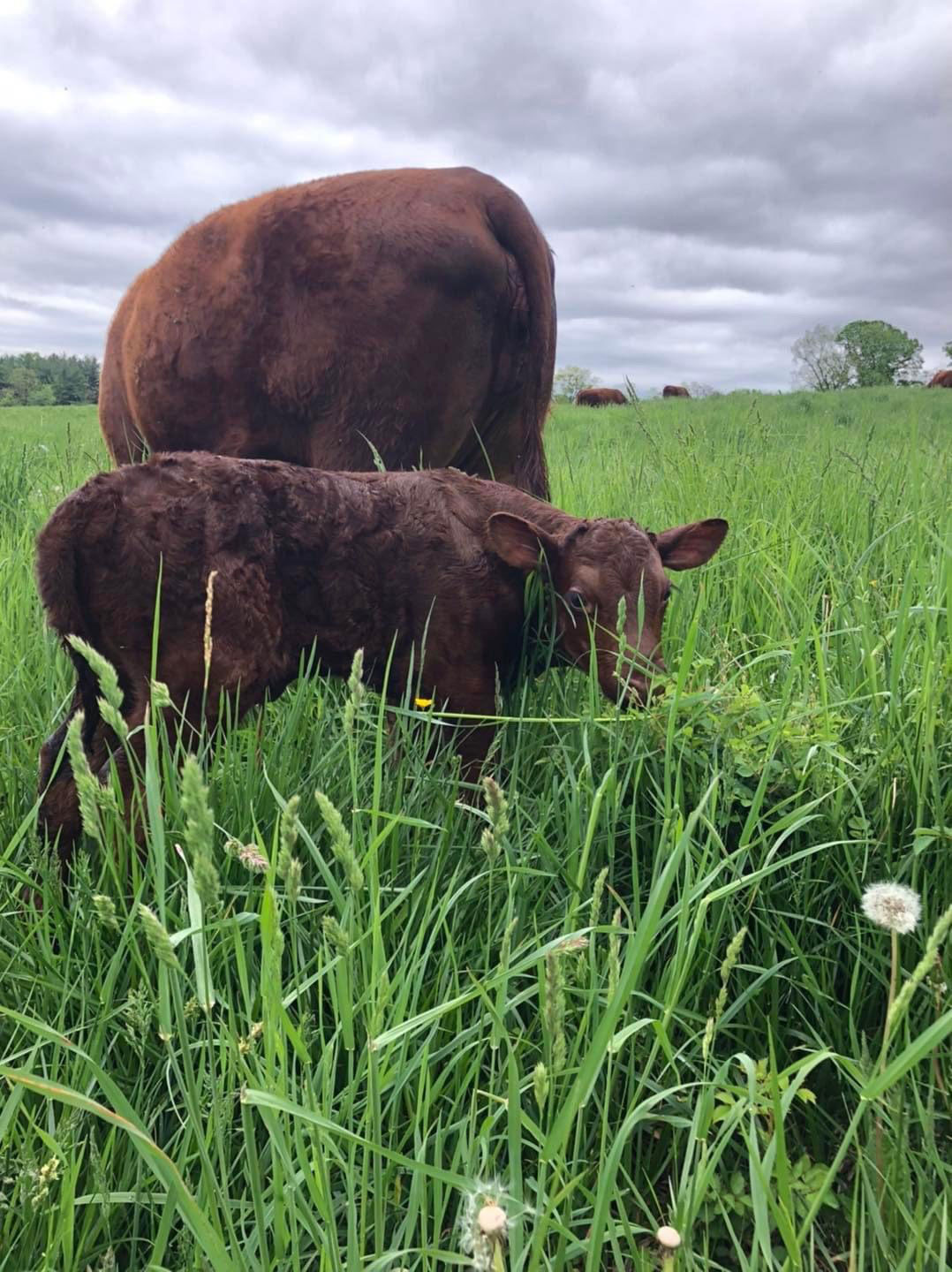
….is help people create quality Devon herds.  And this two-month old heifer, at Tomina Farms in Kentucky, is an example.  She’s by a bull we sold Regina and Tom Tesnow just over a year ago and we get frequent updates.  They’re not only happy with the results but with the bull’s temperament and role in their pasture; so happy that they’re thinking of collecting semen from him.

Best, of course, is to create your own bull on your own pasture but that takes a little skill and a lot of patience and luck.  The greatest impact ever on our herd took place about four years ago when we spotted and bought a bull from Watson farm in Rhode Island.  His daughters and sons are now producing their own great calves here and they’re often the first to go when “shoppers” come by.

Certainly artificial insemination and embryo transplants can have a major role in a breeding program and we do a lot of that here.  But we’ve found that calves produced that way sometimes lack the vitality of a natural calf.  In our experience it takes at least two and more often three generations to get the results you’re hoping for from that “calf in the canister”.